what would happen to earth if the sun exploded
When will the sunday explode?
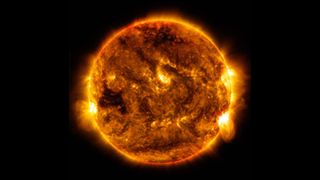
According to Beatles singer-songwriter George Harrison, all things must pass, and according to decades of mathematical and astronomical models, these things include the sun.
And so, when is the sun expected to burn out?
Though the ultimate death of our medium-size solar mass is trillions of years in the futurity, the sun's "life" in its current phase, known as its "primary sequence" — in which the nuclear fusion of hydrogen allows it to radiate energy and provide enough pressure to go on the star from collapsing nether its own mass — will end virtually five billion years from at present.
"The sun is a footling less than 5 billion years old," said Paola Testa, an astrophysicist at the Center for Astrophysics, a collaboration between the Smithsonian Astrophysical Observatory and Harvard Higher Observatory. "It's a kind of centre-age star, in the sense that its life is going to be of the order of 10 billion years or so."
Related: Why practise the planets in the solar system orbit on the same airplane?
Subsequently the lord's day has burned through virtually of the hydrogen in its core, it volition transition to its next phase as a red behemothic. At this indicate roughly 5 billion years in the future, the lord's day will stop generating heat via nuclear fusion, and its core will get unstable and contract, according to NASA (opens in new tab). Meanwhile, the outer office of the sun, which will yet contain hydrogen, volition expand, glowing reddish as information technology cools. This expansion will gradually consume the sun's neighboring planets, Mercury and Venus, and ratchet up the sun's solar winds to the point that they quash Earth's magnetic field and strip off its temper.
Of course, this will near certainly exist bad news for whatsoever life remains on our planet by that betoken — assuming whatsoever has survived the 10% increment in the sun's effulgence that is expected to vaporize Earth'south oceans in 1 billion to 1.five billion years, according to a 2014 study published in Geophysical Research Letters (opens in new tab). Inside a few one thousand thousand years of this initial expansion, it's likely that the sun will also consume the rocky remains of the World, according to a 2008 study published in the Monthly Notices of the Majestic Astronomical Club (opens in new tab).
The lord's day volition and so begin fusing the helium left over from hydrogen fusion into carbon and oxygen, earlier ultimately collapsing down to its core, leaving backside a gorgeous planetary nebula — a glowing shell of hot, leftover plasma — in its outer layers as information technology shrinks to an incredibly dense, significantly hotter, Globe-size stellar corpse known equally a white dwarf. The nebula will be visible for only almost 10,000 years, Testa said — the blink of an eye in catholic time. From there, what remains of the sun will spend trillions of years cooling off earlier ultimately becoming a not-emitting object.
To arrive at this timeline for both the lord's day and all stars of its relative mass, scientists needed to know how it emitted energy, which was hard before nuclear fusion in solar masses could be taken into business relationship.
"A lot of the scientific discipline is relatively new, like in the last century, because an integral part of understanding how a star works comes from agreement nuclear reactions and fusion," said Testa, who researches the heating mechanisms and processes of X-ray emissions, such every bit solar flares, in the outer layers of the sun's atmosphere. "Before the 1930s, one of the main ideas of how stars worked was that energy was coming just from gravitational energy."
One time astronomers and astrophysicists had a amend understanding of fusion, they were able to come up upwardly with more complete models, coupled with emission data observed from several stars, for the lives of stars.
"Past putting together lots of different information from lots of unlike stars, astronomers and astrophysicists could build a model for how stars evolve," Testa told Live Scientific discipline. "This gives united states of america a rather precise guess of how old the sun is."
This age — around 4.6 billion to 4.7 billion years old — is too corroborated by radioactive dating of the
oldest known meteorites (opens in new tab), which formed from the same solar nebula, a swirling disk of gas and grit, that gave ascension to the lord's day and planetary bodies in the solar system.
Thanks to these tools, scientists take a proficient agreement of when the sun's low-cal volition eventually burn out and fade away.
Originally published on Alive Science.
Source: https://www.livescience.com/when-will-sun-explode
0 Response to "what would happen to earth if the sun exploded"
Post a Comment