What is an objects acceleration if it is moving at 30 m/s and comes to a stop in 5 s?
11 ii.v Motility Equations for Constant Dispatch in I Dimension
Summary
- Calculate displacement of an object that is non acceleration, given initial position and velocity.
- Calculate terminal velocity of an accelerating object, given initial velocity, acceleration, and time.
- Calculate displacement and final position of an accelerating object, given initial position, initial velocity, time, and acceleration.
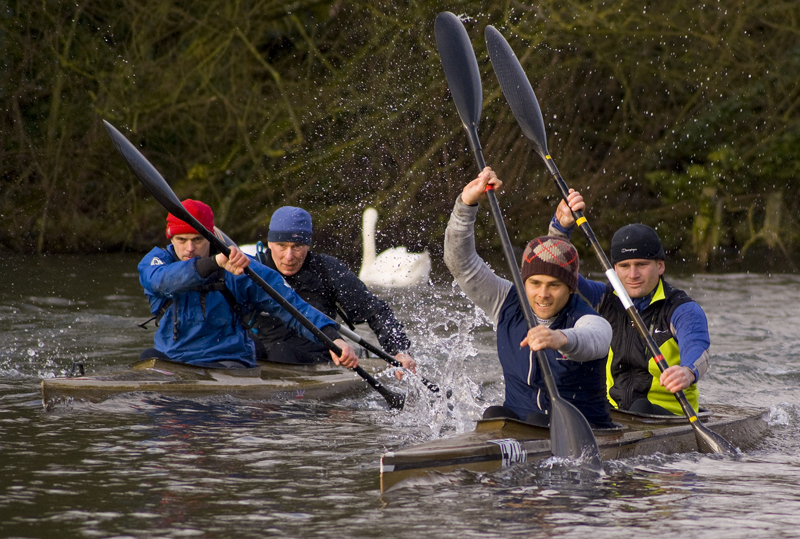
We might know that the greater the acceleration of, say, a car moving abroad from a stop sign, the greater the displacement in a given time. But we have not developed a specific equation that relates acceleration and deportation. In this department, we develop some user-friendly equations for kinematic relationships, starting from the definitions of displacement, velocity, and acceleration already covered.
Note: t, 10, v, a
First, let us make some simplifications in notation. Taking the initial fourth dimension to be zero, as if time is measured with a stopwatch, is a great simplification. Since elapsed time is  , taking
  means that
  , the concluding time on the stopwatch. When initial time is taken to be zero, nosotros employ the subscript 0 to denote initial values of position and velocity. That is,
  is the initial position and
  is the initial velocity. We put no subscripts on the terminal values. That is,
  is the final fourth dimension,
  is the terminal position, and
  is the terminal velocity. This gives a simpler expression for elapsed fourth dimension—now,
  . It besides simplifies the expression for displacement, which is at present
  . Likewise, information technology simplifies the expression for change in velocity, which is now
  . To summarize, using the simplified notation, with the initial fourth dimension taken to exist cypher,
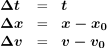 [latex size="4″]\rbrace[/latex]
where the subscript 0 denotes an initial value and the absence of a subscript denotes a final value in whatever movement is nether consideration.
We at present make the of import supposition that acceleration is abiding. This assumption allows u.s. to avoid using calculus to discover instantaneous acceleration. Since acceleration is abiding, the average and instantaneous accelerations are equal. That is,

so we use the symbol  for acceleration at all times. Assuming acceleration to be constant does not seriously limit the situations we can study nor degrade the accurateness of our treatment. For one thing, acceleration is constant in a groovy number of situations. Furthermore, in many other situations we can accurately describe motion past assuming a constant acceleration equal to the boilerplate dispatch for that motion. Finally, in motions where acceleration changes drastically, such as a car accelerating to summit speed and then braking to a stop, the motion tin can be considered in dissever parts, each of which has its own constant acceleration.
SOLVING FOR Deportation (Δten) AND FINAL POSITION (x) FROM Average VELOCITY WHEN ACCELERATION (a) IS Abiding
To become our first 2 new equations, we start with the definition of average velocity:

 .
.
Substituting the simplified notation for  and
and  yields
 .
.
Solving for yields
 ,
,
where the average velocity is

 .
.
The equation [latex size="1″]\boldsymbol{\frac{{v}_0+{v}}{ii}}[/latex]reflects the fact that, when acceleration is constant, is merely the uncomplicated average of the initial and final velocities. For case, if you steadily increase your velocity (that is, with constant acceleration) from 30 to 60 km/h, so your boilerplate velocity during this steady increase is 45 km/h. Using the equation [latex size="1″]\boldsymbol{\frac{{v}_0+{five}}{2}}[/latex] to check this, we see that



 ,
,
which seems logical.
Example ane: Calculating Displacement: How Far does the Jogger Run?
A jogger runs down a direct stretch of route with an average velocity of iv.00 m/south for 2.00 min. What is his final position, taking his initial position to be naught?
Strategy
Draw a sketch.
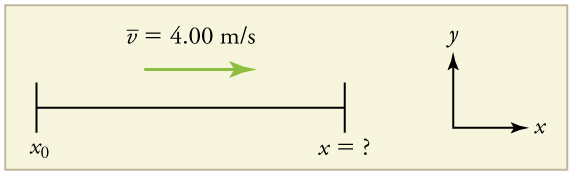
The final position is given by the equation
 .
.
To find , we identify the values of ,  , and from the argument of the problem and substitute them into the equation.
Solution
1. Place the knowns.  ,
,  , and
, and  .
.
ii. Enter the known values into the equation.

Discussion
Velocity and terminal displacement are both positive, which means they are in the same direction.
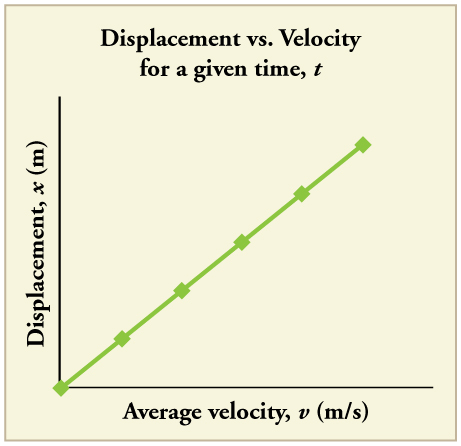
The equation gives insight into the relationship between displacement, boilerplate velocity, and time. It shows, for example, that displacement is a linear function of boilerplate velocity. (By linear office, we mean that deportation depends on rather than on raised to some other power, such as  . When graphed, linear functions look similar straight lines with a constant gradient.) On a car trip, for example, we volition get twice equally far in a given time if we average 90 km/h than if nosotros average 45 km/h.
SOLVING FOR Terminal VELOCITY
We can derive another useful equation by manipulating the definition of acceleration.


Substituting the simplified notation for  and gives us


 .
.
Solving for yields
 .
.
Example 2: Computing Final Velocity: An Plane Slowing Down after Landing
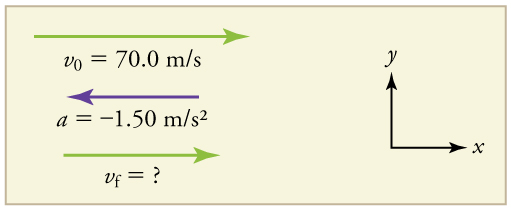
An airplane lands with an initial velocity of 70.0 grand/south then decelerates at  for 40.0 southward. What is its final velocity?
Strategy
Draw a sketch. We draw the acceleration vector in the direction opposite the velocity vector because the plane is decelerating.
Solution
ane. Identify the knowns.  ,
,  ,
,  .
.
2. Place the unknown. In this case, it is terminal velocity,  .
.
iii. Determine which equation to utilise. We tin can calculate the final velocity using the equation  .
.
iv. Plug in the known values and solve.

Discussion
The final velocity is much less than the initial velocity, as desired when slowing down, but even so positive. With jet engines, reverse thrust could exist maintained long enough to terminate the aeroplane and start moving it backward. That would exist indicated by a negative final velocity, which is not the case here.

In addition to beingness useful in trouble solving, the equation gives us insight into the relationships amid velocity, acceleration, and fourth dimension. From information technology we can see, for example, that
(All of these observations fit our intuition, and it is always useful to examine basic equations in low-cal of our intuition and experiences to check that they do indeed describe nature accurately.)
MAKING CONNECTIONS: Real Globe CONNECTION
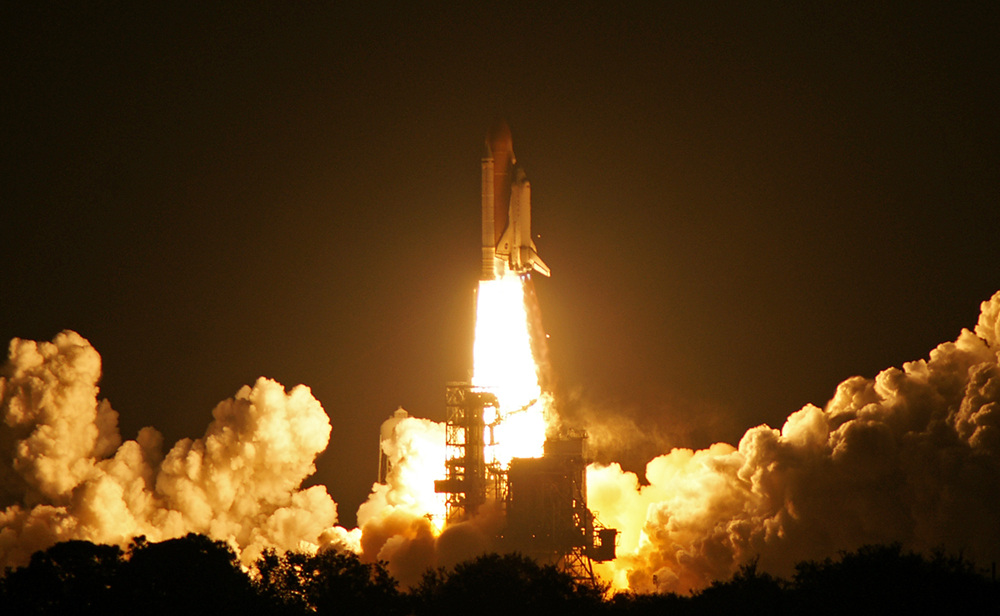
An intercontinental ballistic missile (ICBM) has a larger average acceleration than the Space Shuttle and achieves a greater velocity in the first minute or two of flight (actual ICBM fire times are classified—curt-burn-time missiles are more hard for an enemy to destroy). But the Infinite Shuttle obtains a greater final velocity, so that information technology can orbit the earth rather than come directly back downward as an ICBM does. The Space Shuttle does this by accelerating for a longer time.
SOLVING FOR Concluding POSITION WHEN VELOCITY IS NOT CONSTANT ( a ≠ 0 )
We tin combine the equations in a higher place to find a tertiary equation that allows us to summate the terminal position of an object experiencing constant acceleration. We start with
.
Adding to each side of this equation and dividing by 2 gives


Since  for constant acceleration, so
 .
.
Now we substitute this expression for into the equation for deportation, , yielding

 .
.
Instance 3: Calculating Deportation of an Accelerating Object: Dragsters
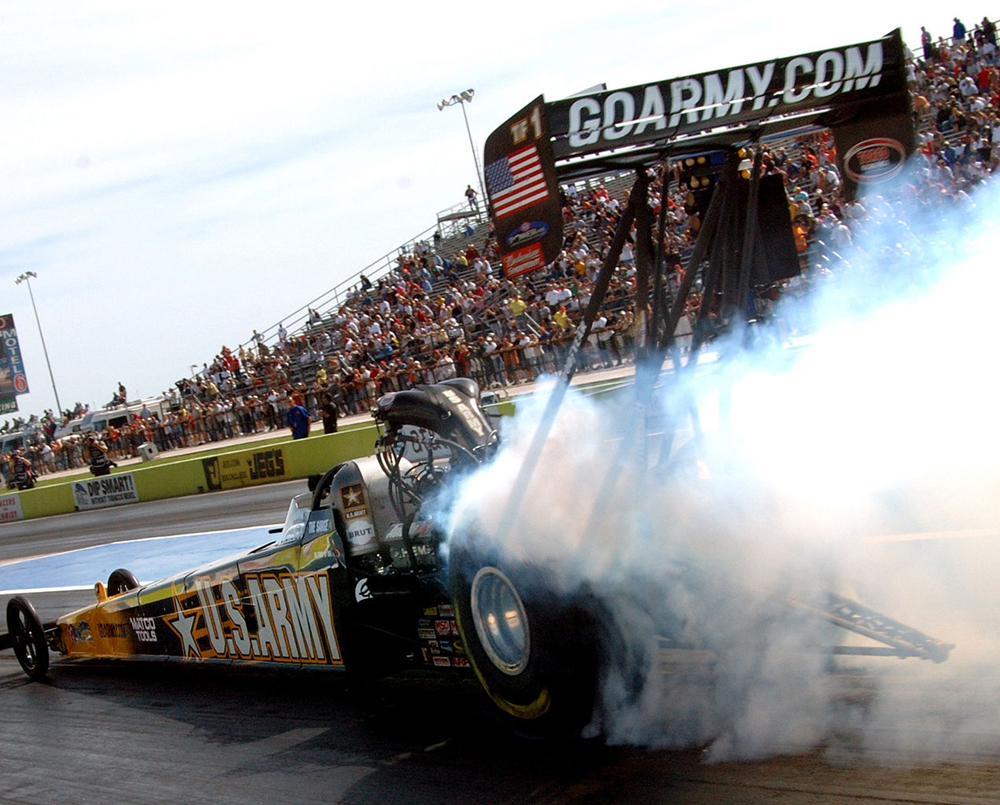
Dragsters can achieve boilerplate accelerations of  . Suppose such a dragster accelerates from rest at this rate for 5.56 s. How far does it travel in this time?
Strategy
Depict a sketch.
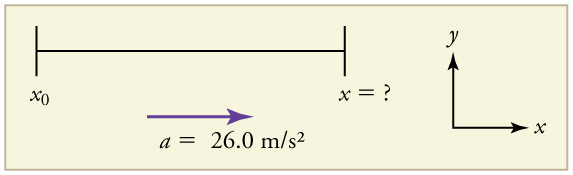
We are asked to observe displacement, which is if we take to be zero. (Recollect most it like the starting line of a race. It can be anywhere, simply nosotros call it 0 and measure all other positions relative to it.) We can utilize the equation  once we identify ,
  , and from the statement of the problem.
Solution
1. Identify the knowns. Starting from residual means that  , is given as
  and is given as 5.56 s.
2. Plug the known values into the equation to solve for the unknown  :
:
.
Since the initial position and velocity are both nil, this simplifies to
 .
.
Substituting the identified values of and gives
 ,
,
yielding
 .
.
Discussion
If we convert 402 m to miles, we notice that the altitude covered is very close to one quarter of a mile, the standard altitude for drag racing. So the answer is reasonable. This is an impressive displacement in only v.56 southward, merely top-notch dragsters can practice a quarter mile in even less time than this.
What else tin can we learn by examining the equation ? We meet that:
SOLVING FOR FINAL VELOCITY WHEN VELOCITY IS Not Abiding ( a ≠ 0 )
A quaternary useful equation can exist obtained from another algebraic manipulation of previous equations.
If we solve for , we become

 .
.
Substituting this and  into , nosotros become
 .Example: Calculating Final Velocity: Dragsters
Example 4: Computing Final Velocity: Dragsters
Calculate the concluding velocity of the dragster in Case 3 without using data about time.
Strategy
Draw a sketch.
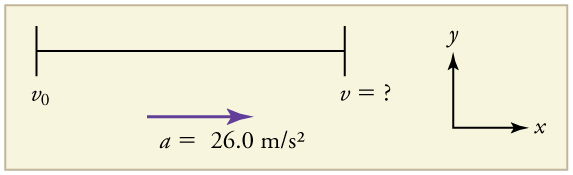
The equation  is ideally suited to this chore because it relates velocities, dispatch, and deportation, and no time information is required.
Solution
ane. Identify the known values. We know that , since the dragster starts from residuum. And so nosotros annotation that  (this was the answer in Example iii). Finally, the boilerplate acceleration was given to be
  .
.
2. Plug the knowns into the equation and solve for .

Thus

To become  , we take the square root:
 .
.
Discussion
145 m/southward is most 522 km/h or almost 324 mi/h, merely even this breakneck speed is curt of the record for the quarter mile. As well, notation that a foursquare root has two values; we took the positive value to indicate a velocity in the aforementioned management as the acceleration.
An test of the equation can produce further insights into the full general relationships among physical quantities:
- The final velocity depends on how large the acceleration is and the distance over which it acts
- For a fixed deceleration, a automobile that is going twice as fast doesn't merely stop in twice the altitude—information technology takes much further to stop. (This is why nosotros have reduced speed zones about schools.)
Putting Equations Together
In the following examples, we further explore ane-dimensional motion, just in situations requiring slightly more than algebraic manipulation. The examples as well give insight into trouble-solving techniques. The box below provides easy reference to the equations needed.
SUMMARY OF KINEMATIC EQUATIONS(CONSTANT a)
[latex size="i″]\boldsymbol{\frac{v_0+v}{2}}[/latex]

Instance five: Calculating Displacement: How Far Does a Car Go When Coming to a Halt?
On dry out concrete, a auto can decelerate at a rate of  , whereas on moisture concrete information technology tin decelerate at only
  . Find the distances necessary to finish a car moving at 30.0 chiliad/s (about 110 km/h) (a) on dry concrete and (b) on wet physical. (c) Repeat both calculations, finding the displacement from the indicate where the commuter sees a traffic lite turn red, taking into account his reaction time of 0.500 s to become his foot on the brake.
Strategy
Draw a sketch.
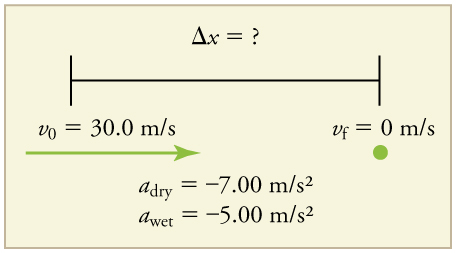
In order to determine which equations are all-time to use, we need to list all of the known values and place exactly what we need to solve for. We shall do this explicitly in the next several examples, using tables to fix them off.
Solution for (a)
1. Identify the knowns and what we want to solve for. We know that  ;
;  ;
;  ( is negative because it is in a management contrary to velocity). We accept to be 0. We are looking for displacement , or
  .
.
two. Identify the equation that volition assist upwardly solve the problem. The best equation to utilise is
.
This equation is best considering information technology includes just ane unknown, . We know the values of all the other variables in this equation. (In that location are other equations that would allow u.s. to solve for , but they require us to know the stopping fourth dimension, , which nosotros do non know. We could utilize them simply it would entail additional calculations.)
iii. Rearrange the equation to solve for .
 [latex size="1″]\boldsymbol{\frac{five^2-v_0^2}{2a}}[/latex]
iv. Enter known values.
 [latex size="1″]\boldsymbol{\frac{0^two-(xxx.0\textbf{ m/s})^two}{two(-vii.00\textbf{ one thousand/south}^ii)}}[/latex]
Thus,

Solution for (b)
This part tin exist solved in exactly the same manner every bit Office A. The simply difference is that the deceleration is  . The result is

Solution for (c)
Once the driver reacts, the stopping distance is the same as it is in Parts A and B for dry and wet concrete. So to answer this question, we need to calculate how far the car travels during the reaction time, and and then add that to the stopping time. It is reasonable to assume that the velocity remains constant during the driver'due south reaction fourth dimension.
1. Identify the knowns and what nosotros want to solve for. We know that  ;
;  ;
;  . We accept
  to be 0. Nosotros are looking for
  .
.
2. Identify the best equation to use.
works well because the only unknown value is , which is what nosotros want to solve for.
3. Plug in the knowns to solve the equation.
 .
.
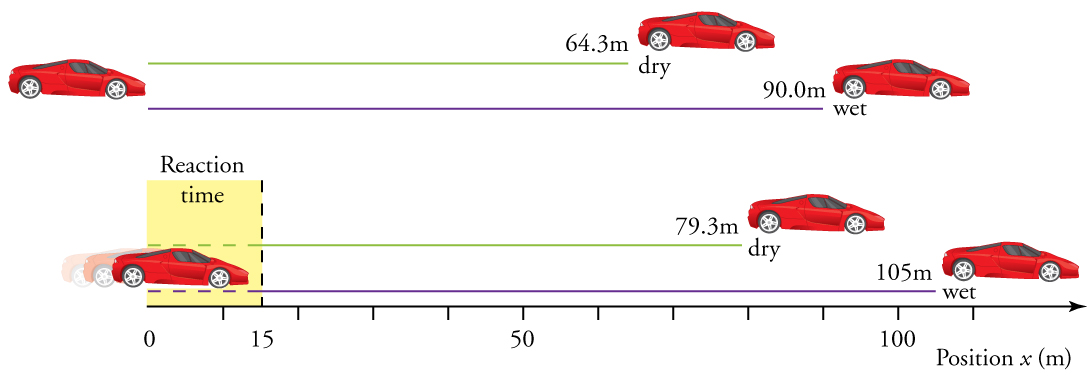
This means the automobile travels xv.0 m while the driver reacts, making the total displacements in the two cases of dry out and wet concrete 15.0 thousand greater than if he reacted instantly.
4. Add the displacement during the reaction time to the displacement when braking.

(a) 64.three k + fifteen.0 m = 79.3 m when dry out
(b) 90.0 m + 15.0 thou = 105 m when moisture
Discussion
The displacements found in this case seem reasonable for stopping a fast-moving machine. Information technology should take longer to terminate a machine on wet rather than dry pavement. It is interesting that reaction time adds significantly to the displacements. But more important is the general arroyo to solving bug. We place the knowns and the quantities to exist determined and so detect an appropriate equation. At that place is often more than one way to solve a problem. The diverse parts of this example tin can in fact be solved by other methods, just the solutions presented above are the shortest.
Example 6: Calculating Time: A Car Merges into Traffic
Suppose a car merges into freeway traffic on a 200-g-long ramp. If its initial velocity is 10.0 m/south and information technology accelerates at  , how long does it have to travel the 200 m upward the ramp? (Such information might be useful to a traffic engineer.)
Strategy
Draw a sketch.
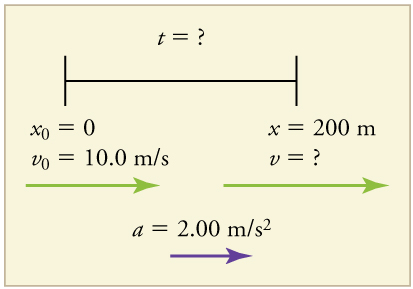
Nosotros are asked to solve for the fourth dimension . As before, nosotros identify the known quantities in guild to choose a convenient physical relationship (that is, an equation with 1 unknown, ).
Solution
1. Place the knowns and what we want to solve for. We know that  ;
;  ; and
; and  .
.
ii. We need to solve for . Choose the best equation. works all-time because the only unknown in the equation is the variable for which we need to solve.
3. Nosotros volition demand to rearrange the equation to solve for . In this example, it will exist easier to plug in the knowns first.

4. Simplify the equation. The units of meters (m) abolish because they are in each term. We tin can get the units of seconds (s) to cancel by taking  , where
  is the magnitude of fourth dimension and s is the unit. Doing so leaves
 .
.
5. Utilise the quadratic formula to solve for .
(a) Rearrange the equation to go 0 on i side of the equation.

This is a quadratic equation of the form

where the constants are  .
.
(b) Its solutions are given by the quadratic formula:
[latex size="one″]\boldsymbol{\frac{-b\pm\sqrt{b^2-4ac}}{2a}}[/latex].
This yields 2 solutions for , which are

In this case, then, the time is  in seconds, or

A negative value for time is unreasonable, since it would mean that the consequence happened 20 s earlier the motion began. We can discard that solution. Thus,

Discussion
Whenever an equation contains an unknown squared, there will be two solutions. In some problems both solutions are meaningful, simply in others, such every bit the higher up, only ane solution is reasonable. The 10.0 s answer seems reasonable for a typical freeway on-ramp.
With the basics of kinematics established, we can keep to many other interesting examples and applications. In the process of developing kinematics, we take also glimpsed a general arroyo to problem solving that produces both correct answers and insights into physical relationships. Chapter 2.6 Trouble-Solving Basics discusses problem-solving basics and outlines an arroyo that will help you lot succeed in this invaluable job.
MAKING CONNECTIONS: TAKE-HOME EXPERIMENT–BREAKING NEWS
Nosotros have been using SI units of meters per second squared to depict some examples of dispatch or deceleration of cars, runners, and trains. To achieve a better feel for these numbers, one can measure the braking deceleration of a car doing a boring (and rubber) cease. Call up that, for average dispatch,  . While traveling in a automobile, slowly apply the brakes as you come up to a stop sign. Take a rider notation the initial speed in miles per 60 minutes and the time taken (in seconds) to stop. From this, calculate the deceleration in miles per hr per second. Convert this to meters per second squared and compare with other decelerations mentioned in this chapter. Calculate the distance traveled in braking.
Check Your Understanding
1: A manned rocket accelerates at a charge per unit of  during launch. How long does information technology take the rocket to attain a velocity of 400 1000/s?
Section Summary
- To simplify calculations nosotros accept dispatch to be constant, then that
 at all times.
 - We as well take initial fourth dimension to be nix.
- Initial position and velocity are given a subscript 0; final values have no subscript. Thus,
[latex size="4″]\rbrace[/latex]
Bug & Exercises
i: An Olympic-class sprinter starts a race with an acceleration of  . (a) What is her speed ii.40 s later? (b) Sketch a graph of her position vs. time for this period.
2: A well-thrown ball is caught in a well-padded mitt. If the deceleration of the ball is  , and 1.85 ms
  elapses from the time the ball get-go touches the mitt until it stops, what was the initial velocity of the brawl?
three: A bullet in a gun is accelerated from the firing chamber to the cease of the barrel at an average rate of  for
for  . What is its muzzle velocity (that is, its final velocity)?
five: While entering a freeway, a car accelerates from rest at a charge per unit of  for 12.0 s. (a) Depict a sketch of the situation. (b) List the knowns in this problem. (c) How far does the car travel in those 12.0 due south? To solve this part, commencement identify the unknown, so discuss how you chose the appropriate equation to solve for information technology. Afterward choosing the equation, show your steps in solving for the unknown, check your units, and hash out whether the respond is reasonable. (d) What is the car'due south final velocity? Solve for this unknown in the same style as in function (c), showing all steps explicitly.
six: At the end of a race, a runner decelerates from a velocity of 9.00 m/due south at a rate of . (a) How far does she travel in the next five.00 due south? (b) What is her final velocity? (c) Evaluate the result. Does information technology make sense?
7: Professional person Application:
Blood is accelerated from rest to xxx.0 cm/s in a distance of one.fourscore cm by the left ventricle of the eye. (a) Brand a sketch of the situation. (b) List the knowns in this problem. (c) How long does the dispatch take? To solve this part, first identify the unknown, and then discuss how you chose the appropriate equation to solve for information technology. After choosing the equation, bear witness your steps in solving for the unknown, checking your units. (d) Is the reply reasonable when compared with the time for a heartbeat?
8: In a slap shot, a hockey player accelerates the puck from a velocity of 8.00 g/s to 40.0 k/s in the same management. If this shot takes  , calculate the distance over which the puck accelerates.
ix: A powerful motorbike tin can accelerate from balance to 26.8 m/south (100 km/h) in only iii.xc southward. (a) What is its boilerplate acceleration? (b) How far does information technology travel in that time?
x: Freight trains tin produce only relatively small-scale accelerations and decelerations. (a) What is the concluding velocity of a freight railroad train that accelerates at a charge per unit of  for eight.00 min, starting with an initial velocity of iv.00 m/due south? (b) If the train can dull down at a charge per unit of
  , how long will it take to come to a cease from this velocity? (c) How far will it travel in each case?
11: A fireworks shell is accelerated from remainder to a velocity of 65.0 m/s over a altitude of 0.250 m. (a) How long did the acceleration final? (b) Calculate the dispatch.
12: A swan on a lake gets airborne by flapping its wings and running on top of the water. (a) If the swan must reach a velocity of half dozen.00 g/s to take off and information technology accelerates from rest at an boilerplate rate of  , how far will it travel earlier becoming airborne? (b) How long does this take?
13: Professional Application:
A woodpecker's brain is peculiarly protected from big decelerations by tendon-like attachments inside the skull. While pecking on a tree, the woodpecker's head comes to a terminate from an initial velocity of 0.600 m/s in a altitude of simply 2.00 mm. (a) Find the acceleration in  and in multiples of
  . (b) Calculate the stopping fourth dimension. (c) The tendons cradling the encephalon stretch, making its stopping altitude four.50 mm (greater than the head and, hence, less deceleration of the brain). What is the brain'due south deceleration, expressed in multiples of
  ?
?
xiv: An unwary football actor collides with a padded goalpost while running at a velocity of vii.50 m/s and comes to a full end after compressing the padding and his body 0.350 thousand. (a) What is his deceleration? (b) How long does the collision last?
fifteen: In World War Ii, there were several reported cases of airmen who jumped from their flaming airplanes with no parachute to escape certain death. Some fell about twenty,000 feet (6000 m), and some of them survived, with few life-threatening injuries. For these lucky pilots, the tree branches and snowfall drifts on the ground immune their deceleration to be relatively minor. If nosotros assume that a pilot's speed upon impact was 123 mph (54 g/south), then what was his deceleration? Assume that the trees and snow stopped him over a distance of 3.0 1000.
16: Consider a grayness squirrel falling out of a tree to the basis. (a) If we ignore air resistance in this case (only for the sake of this problem), determine a squirrel's velocity just earlier striking the footing, assuming it fell from a height of three.0 yard. (b) If the squirrel stops in a altitude of 2.0 cm through angle its limbs, compare its deceleration with that of the airman in the previous problem.
17: An express railroad train passes through a station. It enters with an initial velocity of 22.0 m/s and decelerates at a charge per unit of  as it goes through. The station is 210 m long. (a) How long is the nose of the train in the station? (b) How fast is it going when the nose leaves the station? (c) If the train is 130 m long, when does the end of the train get out the station? (d) What is the velocity of the cease of the train equally it leaves?
eighteen: Dragsters tin actually reach a height speed of 145 m/s in but 4.45 s—considerably less time than given in Example iii and Example four. (a) Summate the boilerplate dispatch for such a dragster. (b) Find the final velocity of this dragster starting from balance and accelerating at the rate found in (a) for 402 m (a quarter mile) without using any data on time. (c) Why is the final velocity greater than that used to observe the average dispatch? Hint: Consider whether the supposition of constant dispatch is valid for a dragster. If not, discuss whether the acceleration would be greater at the beginning or end of the run and what effect that would accept on the concluding velocity.
19: A cycle racer sprints at the end of a race to assure a victory. The racer has an initial velocity of xi.five thousand/s and accelerates at the rate of  for 7.00 s. (a) What is his concluding velocity? (b) The racer continues at this velocity to the stop line. If he was 300 m from the finish line when he started to accelerate, how much time did he relieve? (c) 1 other racer was v.00 thousand ahead when the winner started to accelerate, but he was unable to advance, and traveled at 11.8 k/southward until the finish line. How far alee of him (in meters and in seconds) did the winner finish?
20: In 1967, New Zealander Burt Munro set the world record for an Indian motorcycle, on the Bonneville Salt Flats in Utah, with a maximum speed of 183.58 mi/h. The i-way form was five.00 mi long. Dispatch rates are frequently described by the fourth dimension information technology takes to attain 60.0 mi/h from residual. If this time was 4.00 s, and Burt accelerated at this charge per unit until he reached his maximum speed, how long did it take Burt to complete the form?
21: (a) A globe record was set for the men's 100-m dash in the 2008 Olympic Games in Beijing by Usain Commodities of Jamaica. Bolt "coasted" across the stop line with a time of 9.69 s. If we presume that Bolt accelerated for 3.00 s to reach his maximum speed, and maintained that speed for the rest of the race, calculate his maximum speed and his dispatch. (b) During the same Olympics, Bolt also set the world record in the 200-m dash with a time of 19.30 s. Using the same assumptions as for the 100-m nuance, what was his maximum speed for this race?
Solutions
Bank check Your Understanding
ane:
(a) 
(b)
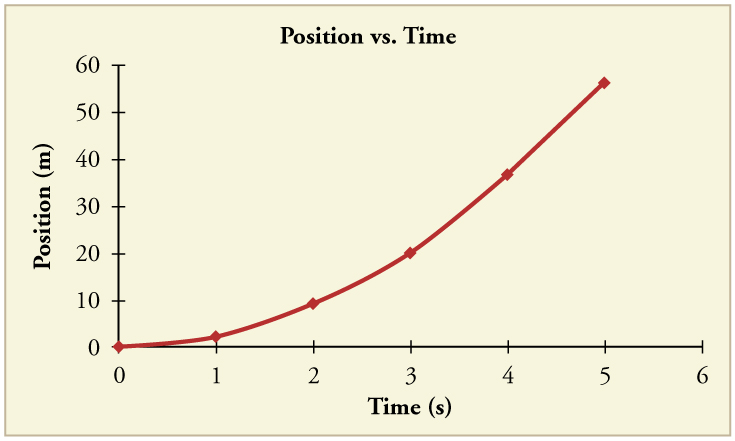
two:
38.nine grand/south (about 87 miles per hour)
four:
6:
(a) 
(b) 
(c) This result does not really brand sense. If the runner starts at 9.00 m/southward and decelerates at , then she will have stopped after iv.50 s. If she continues to decelerate, she volition be running backwards.
viii:

ten:
(a) 
(b) 
(c) 7.68 km to advance and 713 m to decelerate
12:
(a) 
(b) 
fourteen:
(a) 
(b) 
sixteen:
(a) 
(b)  . This is almost 3 times the deceleration of the pilots, who were falling from thousands of meters high!
18:
(a) 
(b) 
(c)  , because the assumption of constant dispatch is not valid for a dragster. A dragster changes gears, and would have a greater acceleration in offset gear than second gear than third gear, etc. The acceleration would exist greatest at the start, and then information technology would non be accelerating at during the terminal few meters, but substantially less, and the last velocity would be less than 162 chiliad/s.
20:
104 s
21:
Source: https://pressbooks.uiowa.edu/clonedbook/chapter/motion-equations-for-constant-acceleration-in-one-dimension/
0 Response to "What is an objects acceleration if it is moving at 30 m/s and comes to a stop in 5 s?"
Post a Comment