what happens to euglena when sunlight is not present
| Euglena | |
|---|---|
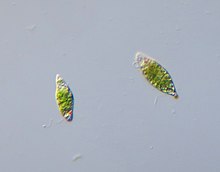 | |
| Euglena sp. | |
Scientific classification  | |
| Domain: | Eukaryota |
| Phylum: | Euglenozoa |
| Course: | Euglenoidea |
| Guild: | Euglenida |
| Family unit: | Euglenaceae |
| Genus: | Euglena Ehrenberg, 1830 |
Euglena is a genus of single jail cell flagellate eukaryotes. It is the best known and most widely studied member of the class Euglenoidea, a various group containing some 54 genera and at least 800 species.[1] [2] Species of Euglena are constitute in fresh water and salt water. They are frequently abundant in quiet inland waters where they may bloom in numbers sufficient to color the surface of ponds and ditches greenish (E. viridis) or cherry (E. sanguinea).[3]
The species Euglena gracilis has been used extensively in the laboratory as a model organism.[iv]
Most species of Euglena have photosynthesizing chloroplasts within the trunk of the jail cell, which enable them to feed by autotrophy, like plants. Still, they can likewise take nourishment heterotrophically, like animals. Since Euglena take features of both animals and plants, early on taxonomists, working within the Linnaean two-kingdom system of biological classification, institute them difficult to allocate.[five] [6] It was the question of where to put such "unclassifiable" creatures that prompted Ernst Haeckel to add a third living kingdom (a fourth kingdom in toto) to the Animale, Vegetabile (and Lapideum meaning Mineral) of Linnaeus: the Kingdom Protista.[7]
Class and function [edit]
When feeding as a heterotroph, Euglena takes in nutrients by osmotrophy, and can survive without lite on a diet of organic thing, such as beef excerpt, peptone, acetate, ethanol or carbohydrates.[8] [9] When there is sufficient sunlight for it to feed by phototrophy, it uses chloroplasts containing the pigments chlorophyll a and chlorophyll b to produce sugars by photosynthesis.[ten] Euglena'south chloroplasts are surrounded by three membranes, while those of plants and the light-green algae (amongst which earlier taxonomists often placed Euglena) have only two membranes. This fact has been taken as morphological bear witness that Euglena'southward chloroplasts evolved from a eukaryotic green alga.[11] Thus, the similarities between Euglena and plants would have arisen not because of kinship but considering of a secondary endosymbiosis. Molecular phylogenetic analysis has lent support to this hypothesis, and it is now generally accepted.[12] [13]

Euglena chloroplasts comprise pyrenoids, used in the synthesis of paramylon, a form of starch free energy storage enabling Euglena to survive periods of light deprivation. The presence of pyrenoids is used as an identifying characteristic of the genus, separating it from other euglenoids, such every bit Lepocinclis and Phacus.[14]
Euglena take two flagella rooted in basal bodies located in a pocket-size reservoir at the front of the cell. Typically, ane flagellum is very short, and does non beetle from the cell, while the other is long enough to be seen with light microscopy. In some species, such every bit Euglena mutabilis, both flagella are "non-emergent"--entirely confined to the interior of the jail cell'south reservoir--and consequently cannot be seen in the light microscope.[15] [16] In species that possess a long, emergent flagellum, it may be used to help the organism swim.[17] The surface of the flagellum is coated with about 30,000 extremely fine filaments chosen mastigonemes.[18]
Like other euglenoids, Euglena possess a cerise eyespot, an organelle composed of carotenoid pigment granules. The red spot itself is non thought to be photosensitive. Rather, it filters the sunlight that falls on a light-detecting construction at the base of the flagellum (a swelling, known as the paraflagellar torso), assuasive only certain wavelengths of calorie-free to reach it. Every bit the cell rotates with respect to the light source, the eyespot partially blocks the source, permitting the Euglena to find the low-cal and move toward information technology (a process known as phototaxis).[xix]

Euglena lacks a prison cell wall. Instead, it has a pellicle made up of a poly peptide layer supported by a substructure of microtubules, arranged in strips spiraling around the jail cell. The action of these pellicle strips sliding over i another, known as metaboly, gives Euglena its exceptional flexibility and contractility.[nineteen] The mechanism of this euglenoid movement is non understood, but its molecular basis may exist similar to that of amoeboid movement.[20]
In low moisture conditions, or when nutrient is scarce, Euglena forms a protective wall around itself and lies dormant as a resting cyst until environmental weather condition ameliorate.
Reproduction [edit]
Euglena reproduce asexually through binary fission, a course of prison cell division. Reproduction begins with the mitosis of the cell nucleus, followed by the division of the cell itself. Euglena divide longitudinally, first at the front cease of the cell, with the duplication of flagellar processes, gullet and stigma. Soon, a cleavage forms in the anterior, and a V-shaped bifurcation gradually moves toward the posterior, until the 2 halves are entirely separated.[21]
Reports of sexual conjugation are rare, and take not been substantiated.[22]
Historical background and early classification [edit]

Cercaria viridis (= Eastward. viridis) from O.F. Müller'south Animalcula Infusoria. 1786
Species of Euglena were amongst the first protists to be seen under the microscope.
In 1674, in a letter of the alphabet to the Majestic Society, the Dutch pioneer of microscopy Antoni van Leeuwenhoek wrote that he had collected water samples from an inland lake, in which he found "animalcules" that were "green in the middle, and before and backside white." Clifford Dobell regards it as "well-nigh sure" that these were Euglena viridis, whose "peculiar arrangement of chromatophores...gives the flagellate this advent at depression magnification."[23]
Twenty-two years later, John Harris published a brief series of "Microscopical Observations" reporting that he had examined "a small Drop of the Dark-green Surface of some Pool-Water" and found it to be "altogether composed of Animals of several Shapes and Magnitudes." Among them, were "oval creatures whose middle role was of a Grass Dark-green, only each end Clear and Transparent," which "would contract and dilate themselves, tumble over and over many times together, and so shoot away like Fish."[24]
In 1786, O.F. Müller gave a more than consummate description of the organism, which he named Cercaria viridis, noting its distinctive color and changeable trunk shape. Müller also provided a series of illustrations, accurately depicting the undulating, contractile movements (metaboly) of Euglena'southward body.[25]

In 1830, C. Yard. Ehrenberg renamed Müller's Cercaria Euglena viridis, and placed it, in keeping with the brusk-lived arrangement of nomenclature he invented, amid the Polygastrica in the family Astasiaea: multi-stomached creatures with no alimentary canal, variable body shape simply no pseudopods or lorica.[26] [27] Past making use of the newly invented achromatic microscope,[28] Ehrenberg was able to encounter Euglena'south eyespot, which he correctly identified as a "rudimentary eye" (although he reasoned, wrongly, that this meant the brute likewise had a nervous system). This feature was incorporated into Ehrenberg's name for the new genus, synthetic from the Greek roots "eu-" (well, good) and glēnē (eyeball, socket of articulation).[29]
Ehrenberg did not notice Euglena 's flagella, however. The first to publish a tape of this feature was Félix Dujardin, who added "filament flagelliforme" to the descriptive criteria of the genus in 1841.[30] Subsequently, the class Flagellata (Cohn, 1853) was created for creatures, like Euglena, possessing one or more flagella. While "Flagellata" has fallen from use as a taxon, the notion of using flagella as a phylogenetic criterion remains vigorous.[31]
Recent phylogeny and classification [edit]

Euglenoid motion, known equally metaboly
In 1881, Georg Klebs fabricated a chief taxonomic distinction between dark-green and colorless flagellate organisms, separating photosynthetic from heterotrophic euglenoids. The latter (largely colorless, shape-changing uniflagellates) were divided among the Astasiaceae and the Peranemaceae, while flexible green euglenoids were generally assigned to the genus Euglena.[32]
As early as 1935, information technology was recognized that this was an artificial grouping, all the same convenient.[33] In 1948, Pringsheim affirmed that the distinction between light-green and colorless flagellates had no taxonomic justification, although he acknowledged its practical entreatment. He proposed something of a compromise, placing colorless, saprotrophic euglenoids in the genus Astasia, while assuasive some colorless euglenoids to share a genus with their photosynthesizing cousins, provided they had structural features that proved common ancestry. Among the green euglenoids themselves, Pringsheim recognized the close kinship of some species of Phacus and Lepocinclis with some species of Euglena.[32]
The thought of classifying the euglenoids by their mode of nourishment was finally abandoned in the 1950s, when A. Hollande published a major revision of the phylum, group organisms past shared structural features, such equally the number and type of flagella.[34] If whatsoever incertitude remained, it was dispelled in 1994, when genetic assay of the non-photosynthesizing euglenoid Astasia longa confirmed that this organism retains sequences of DNA inherited from an ancestor that must have had functioning chloroplasts.[35]
In 1997, a morphological and molecular study of the Euglenozoa put Euglena gracilis in shut kinship with the species Khawkinea quartana, with Peranema trichophorum basal to both.[36] Two years later, a molecular analysis showed that E. gracilis was, in fact, more than closely related to Astasia longa than to certain other species recognized as Euglena. In 2015, Dr Ellis O'Neill and Professor Rob Field have sequenced the transcriptome of Euglena gracilis, which provides information about all of the genes that the organism is actively using. They found that Euglena gracilis has a whole host of new, unclassified genes which can make new forms of carbohydrates and natural products.[37] [38]
The venerable Euglena viridis was establish to be genetically closer to Khawkinea quartana than to the other species of Euglena studied.[34] Recognizing the polyphyletic nature of the genus Euglena, Marin et al. (2003) take revised it to include certain members traditionally placed in Astasia and Khawkinea.[14]
Man consumption [edit]
The taste of powdered euglena is described every bit dried sardine flakes, and contains minerals, vitamins and docosahexaenoic, an omega-3 acid. The powder is used as ingredient in other foods.[39] Kemin Industries sells a euglena nutraceutical supplement ingredient featuring dried Euglena gracilis with high levels of beta glucan.[40]
Feedstock for biofuel production [edit]
The lipid content of Euglena (mainly wax esters) is seen as a promising feedstock for production of biodiesel and jet fuel.[41] Nether the aegis of Itochu, a showtime-upwardly company chosen Euglena Co., Ltd. has completed a refinery plant in Yokohama in 2018, with a product capacity of 125 kiloliters of bio jet fuel and biodiesel per year.[42] [43]
Video gallery [edit]
| Euglena mutabilis, showing metaboly, paramylon bodies and chloroplasts |
| Euglena, moving by metaboly and swimming |
Come across likewise [edit]
- Elysia chlorotica
- Kleptoplasty
References [edit]
- ^ "The Euglenoid Project: Alphabetic Listing of Taxa". The Euglenoid Project. Partnership for Enhancing Expertise in Taxonomy. Archived from the original on February 23, 2017. Retrieved Sep 20, 2014.
- ^ "The Euglenoid Project for Teachers". The Euglenoid Project for Teachers. Partnerships for Enhancing Expertise in Taxonomy. Archived from the original on Feb 23, 2017. Retrieved Sep 20, 2014.
- ^ Wolosski, Konrad (2002-04-25). "Phylum Euglenophyta". In John, David M.; Whitton, Brian A.; Beck, Alan J. (eds.). The Freshwater Algal Flora of the British Isles: an Identification Guide to Freshwater and Terrestrial Algae. p. 144. ISBN978-0-521-77051-iv.
- ^ Russell, A. G.; Watanabe, Y; Charette, JM; Grey, MW (2005). "Unusual features of fibrillarin cDNA and factor construction in Euglena gracilis: Evolutionary conservation of core proteins and structural predictions for methylation-guide box C/D snoRNPs throughout the domain Eucarya". Nucleic Acids Enquiry. 33 (9): 2781–91. doi:10.1093/nar/gki574. PMC1126904. PMID 15894796.
- ^ Margulis, Lynn (2007). "Power to the Protoctists". In Margulis, Lynn; Sagan, Dorion (eds.). Dazzle Gradually: Reflections on the Nature of Nature. White River Junction: Chelsea Green. pp. 29–35. ISBN978-i-60358-136-3.
- ^ Keeble, Frederick (1912). Found-animals: a study in symbiosis. London: Cambridge University Press. pp. 103–4. OCLC 297937639.
- ^ Solomon, Eldra Pearl; Berg, Linda R.; Martin, Diana W., eds. (2005). "Kingdoms or Domains?". Biological science (7th ed.). Belmont: Brooks/Cole Thompson Learning. pp. 421–7. ISBN978-0-534-49276-2.
- ^ Leadbeater, Barry S. C.; Green, John C. (2002-09-11). Flagellates: Unity, Multifariousness and Evolution. CRC Press. ISBN9780203484814.
- ^ Pringsheim, Due east. Thousand.; Hovasse, R. (1948-06-01). "The Loss of Chromatophores in Euglena Gracilis". New Phytologist. 47 (ane): 52–87. doi:10.1111/j.1469-8137.1948.tb05092.x.
- ^ Nisbet, Brenda (1984). Nutrition and Feeding Strategies in Protozoa. p. 73. ISBN978-0-7099-1800-iv.
- ^ Gibbs, Sarah P. (1978). "The chloroplasts of Euglena may have evolved from symbiotic green algae". Canadian Journal of Botany. 56 (22): 2883–9. doi:x.1139/b78-345.
- ^ Henze, Katrin; Badr, Abdelfattah; Wettern, Michael; Cerff, Rudiger; Martin, William (1995). "A Nuclear Gene of Eubacterial Origin in Euglena gracilis Reflects Cryptic Endosymbioses During Protist Evolution". Proceedings of the National Academy of Sciences of the United states of america of America. 92 (20): 9122–6. Bibcode:1995PNAS...92.9122H. doi:x.1073/pnas.92.20.9122. JSTOR 2368422. PMC40936. PMID 7568085.
- ^ Nudelman, Mara Alejandra; Rossi, Mara Susana; Conforti, Visitacin; Triemer, Richard Due east. (2003). "Phylogeny of euglenophyceae based on small subunit rDNA sequences: Taxonomic implications". Journal of Phycology. 39 (1): 226–35. doi:x.1046/j.1529-8817.2003.02075.ten. S2CID 85275367.
- ^ a b Marin, B; Palm, A; Klingberg, M; Melkonian, G (2003). "Phylogeny and taxonomic revision of plastid-containing euglenophytes based on SSU rDNA sequence comparisons and synapomorphic signatures in the SSU rRNA secondary structure". Protist. 154 (i): 99–145. doi:10.1078/143446103764928521. PMID 12812373.
- ^ Ciugulea, Ionel; Triemer, Richard (2010). A Color Atlas of Photosynthetic Euglenoids. East Lansing: Michigan Country University Press. pp. 17 & 38. ISBN978-0870138799.
- ^ Häder, Donat-P.; Melkonian, Michael (1983-08-01). "Phototaxis in the gliding flagellate, Euglena mutabilis". Archives of Microbiology. 135 (ane): 25–29. doi:x.1007/BF00419477. ISSN 1432-072X. S2CID 19307809.
- ^ Rossi, Massimiliano; Cicconofri, Giancarlo; Beran, Alfred; Noselli, Giovanni; DeSimone, Antonio (2017-12-12). "Kinematics of flagellar swimming in Euglena gracilis: Helical trajectories and flagellar shapes". Proceedings of the National Academy of Sciences. 114 (50): 13085–13090. doi:10.1073/pnas.1708064114. ISSN 0027-8424. PMC5740643. PMID 29180429.
- ^ Bouck, M. B.; Rogalski, A.; Valaitis, A. (1978-06-01). "Surface organization and composition of Euglena. II. Flagellar mastigonemes". The Journal of Jail cell Biology. 77 (3): 805–826. doi:10.1083/jcb.77.3.805. ISSN 0021-9525. PMC2110158. PMID 98532.
- ^ a b Schaechter, Moselio (2011). Eukaryotic Microbes. San Diego: Elsevier/Academic Press. p. 315. ISBN978-0-12-383876-vi.
- ^ O'Neill, Ellis (2013). An exploration of phosphorylases for the synthesis of saccharide polymers (PhD thesis). Academy of East Anglia. pp. 170–171.
- ^ Gojdics, Mary (1934). "The Jail cell Morphology and Sectionalisation of Euglena deses Ehrbg". Transactions of the American Microscopical Society. 53 (4): 299–310. doi:ten.2307/3222381. JSTOR 3222381.
- ^ Lee, John J. (2000). An Illustrated Guide to the Protozoa: organisms traditionally referred to as protozoa, or newly discovered groups. Vol. ii (2nd ed.). Lawrence, Kansas: Gild of Protozoologists. p. 1137.
- ^ Dobell, Clifford (1960) [1932]. Antony van Leeuwenhoek and his 'Footling Animals' . New York: Dover. p. 111. ISBN978-0-486-60594-4.
- ^ Harris, J. (1695). "Some Microscopical Observations of Vast Numbers of Animalcula Seen in Water by John Harris, M. A. Kector of Winchelsea in Sussex, and F. R. Southward". Philosophical Transactions of the Majestic Society of London. 19 (215–235): 254–ix. Bibcode:1695RSPT...19..254H. doi:ten.1098/rstl.1695.0036. JSTOR 102304.
- ^ Müller, Otto Frederik; Fabricius, Otto (1786). Animalcula Infusoria, Fluvia Tilia et Marina. Hauniae, Typis North. Mölleri. pp. 126, 473.
- ^ Ehrenberg, C. Organisation, Systematik und geographisches Verhältnifs der Infusionsthierchen. Vol. Ii. Berlin, 1830. pp 58-ix
- ^ Pritchard, Andrew (1845). A history of Infusoria, living and fossil: bundled co-ordinate to 'Dice Infusionsthierchen' of C.One thousand. Ehrenberg. London: Whittaker. p. 86. hdl:2027/uc2.ark:/13960/t5fb4z64c.
- ^ "Notes and Queries". Notes and Queries. 12 (13): 459. July–December 1855.
- ^ "Merriam-Webster online dictionary". Encyclopædia Britannica . Retrieved half-dozen July 2005.
- ^ Dujardin, Félix (1841). Histoire Naturelle des Zoophytes. Infusoires, comprenant la Physiologie et la Classification de ces Animaux, et la Manière de les Étudier a l'aide du Microscope. Paris. p. 358.
- ^ Condescending-Smith, Thomas; Chao, Ema East.-Y. (2003). "Phylogeny and Classification of Phylum Cercozoa (Protozoa)". Protist. 154 (three–4): 341–58. doi:10.1078/143446103322454112. PMID 14658494. S2CID 26079642.
- ^ a b Pringsheim, E. M. (1948). "Taxonomic Problems in the Euglenineae". Biological Reviews. 23 (ane): 46–61. doi:ten.1111/j.1469-185X.1948.tb00456.x. PMID 18901101. S2CID 33439406.
- ^ Schwartz, Adelheid (2007). "F. E. Fritsch, the Structure and Reproduction of the Algae Vol. I/Two. XIII und 791, Xiv und 939 Due south., 245 und 336 Abb., 2 und 2 Karten. Cambridge 1965 (reprinted): Cambridge University Press 90 S je Band". Zeitschrift für Allgemeine Mikrobiologie. vii (2): 168–9. doi:ten.1002/jobm.19670070220.
- ^ a b Linton, Eric West.; Hittner, Dana; Lewandowski, Carole; Auld, Theresa; Triemer, Richard E. (1999). "A Molecular Report of Euglenoid Phylogeny using Small Subunit rDNA". The Journal of Eukaryotic Microbiology. 46 (2): 217–23. doi:10.1111/j.1550-7408.1999.tb04606.10. PMID 10361741. S2CID 31420687.
- ^ Gockel, Gabriele; Hachtel, Wolfgang; Baier, Susanne; Fliss, Christian; Henke, Marking (1994). "Genes for components of the chloroplast translational appliance are conserved in the reduced 73-kb plastid DNA of the nonphotosynthetic euglenoid flagellate Astasia longa". Current Genetics. 26 (three): 256–62. doi:10.1007/BF00309557. PMID 7859309. S2CID 8082617.
- ^ Montegut-Felkner, Ann E.; Triemer, Richard Due east. (1997). "Phylogenetic Relationships of Selected Euglenoid Genera Based on Morphological and Molecular Data". Journal of Phycology. 33 (3): 512–9. doi:x.1111/j.0022-3646.1997.00512.10. S2CID 83579360.
- ^ The potential in your pond published on Baronial 14, 2015 by the "John Innes Centre"
- ^ O'Neill, Ellis C.; Trick, Martin; Hill, Lionel; Rejzek, Martin; Dusi, Renata G.; Hamilton, Christopher J.; Zimba, Paul V.; Henrissat, Bernard; Field, Robert A. (2015). "The transcriptome of Euglena gracilis reveals unexpected metabolic capabilities for carbohydrate and natural product biochemistry". Molecular BioSystems. eleven (10): 2808–21. doi:ten.1039/C5MB00319A. PMID 26289754.
- ^ "Tiny euglena latest fad in eating healthy". The Japan Times. 23 January 2014.
- ^ "BetaVia™". Kemin . Retrieved 2021-09-sixteen .
- ^ Toyama, Tadashi; Hanaoka, Tsubasa (2019). "Enhanced production of biomass and lipids past Euglena gracilis via co-culturing with a microalga growth-promoting bacterium". Biotechnology for Biofuels. 12: 205. doi:10.1186/s13068-019-1544-2. PMC6822413. PMID 31695747.
- ^ Okutsu, Akane (2018). "Biotech company euglena teams with ANA to fuel light-green commercial flights". Nikkei (published November two, 2018). Retrieved April 8, 2020.
- ^ Video explanation lacks technical details but suggests degree of government commitment to solving problems of large-scale cultivation and infrastructure. CEO of Euglena Co. wears euglena-greenish necktie. "Fueling Jet Aircraft With Microalgae: Growing biofuel without farmlands". JapanGov. The Government of Japan. Retrieved Apr 8, 2020.
External links [edit]
 | Look up euglena in Wiktionary, the free dictionary. |
- The Euglenoid Project
- Tree of Life spider web project: Euglenida
- Protist Images: Euglena
- Euglena at Droplet - Microscopy of the Protozoa
- Images and taxonomy
- Constantopoulos, George; Bloch, Konrad (1967). "Issue of Light Intensity on the Lipid Composition of Euglena gracilis". The Journal of Biological Chemistry. 242 (15): 3538–42. doi:10.1016/S0021-9258(xviii)95895-3.
Source: https://en.wikipedia.org/wiki/Euglena
0 Response to "what happens to euglena when sunlight is not present"
Post a Comment