Fountas and Pinnell Kindergarten Reading Strategies by Level
Fountas & Pinnell reading levels (commonly referred to as "Fountas & Pinnell") are a organisation of reading levels developed by Irene Fountas and Gay Su Pinnell to back up their guided reading method.[1] Reading text is classified according to various parameters, such as word count, number of different words, number of high-frequency words, sentence length, judgement complexity, word repetitions, illustration support, etc. While classification is guided past these parameters, syllable blazon, an important consideration in beginning reading, is not considered as role of the leveling system. Small books containing a combination of text and illustrations are and then provided to educators for each level.[2]
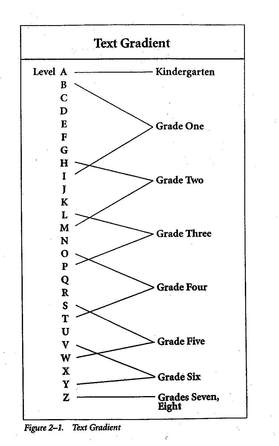
While young children brandish a wide distribution of reading skills, each level is tentatively associated with a schoolhouse course. Some schools adopt target reading levels for their pupils. This is the form-level equivalence nautical chart recommended by Fountas & Pinnell.[3]
| Recommended grade | Fountas and Pinnell level |
|---|---|
| K | A, B, C |
| 1 | C, D, East, F, G, H, I |
| two | I, J, Thousand, L, Thousand |
| 3 | M, N, O, P |
| iv | P, Q, R, Due south |
| 5 | S, T, U, Five |
| 6 | V, W, X, Y |
| seven | Y, Z |
| 8 and in a higher place | Z |
Alternative classifications of reading difficulties have been developed past diverse authors (Reading Recovery levels, DRA levels, Basal Levels, Lexile Levels, etc.).
Fountas and Pinnell Reading Level Characteristics
Instructional Level: With pedagogy and support, the child can read the text.
Independent Level: Text the child can easily read and understand on his/her own.

The Fountas and Pinnell Assessment System in one mode our district identifies a student'southward reading level. The cess provides valuable data most reading accuracy, comprehension, fluency, and more. This is only one tool used to determine your child'south strengths and weaknesses. They read a combination of fiction and nonfiction books, mistakes are recorded, and questions are asked to gauge understanding of the text. Students must be able to verbalize their thoughts for this type of assessment. An expected one year growth may be iii-four levels; therefore, if they are unable to brand these gains each year they volition have farthermost difficulty reaching the grade level expectation.
The assessments are done at…
- Kickoff of the yr (August-September)
- Mid-yr (November-December)
- End of the year (April-May)
The assessment can…
- Determine your child's "independent" and "instructional" reading level
- INDEPENDENT-Read with 95-99% accurateness with satisfactory comprehension
- INSTRUCTIONAL-Read with 90-94% accuracy with satisfactory comprehension
- Determine reading placement levels and group students for instruction
- Place students who need interventions
- Assess the outcomes of instruction strategies
- Document pupil progress during a schoolhouse year and over several years
- Inform parents of progress over a menstruum of fourth dimension
If your child is reading below grade level at this time, it'southward not uncommon for them to score lower on classroom assessments. These levels have been tracked for several years; therefore, information technology'south unrealistic to recollect they tin take hold of upward to grade level in ane year if they begin the yr reading several levels below grade level.
The comprehension portion includes three types of questions, and students tin score from a 1-3 in each area:
- Within the Text-Retell or summarize the story and identify the problem.
- Beyond the Text-Indicates your kid's ability to connect to their own experiences with the story and depict conclusions most characters or events.
- Near the Text-Indicates your child's ability to call up almost the author'southward purpose, mode of writing, or how the text is organized.
Cocky-Correction
- A self-correction rate of 1:4 means that the student corrects approximately 1 out of every 4 errors made during the reading. If a student has a charge per unit of 1:4 or less, this indicates that he/she is self-monitoring or cocky-correcting his/her reading. It lets you know that they are very enlightened of their reading abilities.
Fluency
- Fluency is how smoothly your child reads with expression and meaning.
Accurateness Rate
- This is the percentage of words read correctly or accurately. An instructional level accuracy rate may fall between xc-100%.
Grade Level Expectations fifth Form
Beginning of Yr-Level S/T
End of Yr-Level V
Anne Arundel County Public Schoolhouse Parents Guide to Guided Reading Levels
The site contains very valuable information regarding your child'southward reading level including the characteristics of this level and strategies for helping improve your child'due south reading level.
| F&P Parent Resources | F&P Recursos de los Padres |
| Parent Guide for Levels A and B | Guia de padres para los niveles A y B |
| Parent Guide for Levels C, D, and Eastward | Guia de padres para los niveles C, D, y Due east |
| Parent Guide for Levels F and K | Guia de padres para los niveles F y One thousand |
| Parent Guide for Level H and I | Guia de padres para los niveles H y I |
| Parent Guide for J and Grand | Guia de padres para los niveles J y K |
| Parent Guide for Levels 50 and Yard | Guia de padres para los niveles Fifty vii M |
| Parent Guide for Levels N, O, P, and Q | Guia de padres para los niveles N, O, P, y Q |
| Parent Guide for Levels R, S, and T | Guia de padres para los niveles R, S, and T |
| Parent Guide for Levels U and V | Guia de padres para los niveles U y Five |
| Parent Guide for Levels Westward, Ten, Y, and Z | Guia de padres para los niveles W, Ten, Y, y Z |
https://www.aacps.org/Page/2447
Volume
The Fountas & Pinnell Literacy Continuum, Expanded Edition
A Tool for Assessment, Planning, and Teaching, PreK-8
Source: https://buildingmomentuminschools.blog/2018/06/12/fountas-pinnell-reading-levels/
0 Response to "Fountas and Pinnell Kindergarten Reading Strategies by Level"
Post a Comment